Diary - 2025 Year in Review
01 Jan 2026This is the fourth year-end review I’ve written since entering the life of a developer in 2022. 2025 was, I think, one of the most memorable years for me. There were incredibly joyful moments, but also incredibly hard stretches. I feel proud of myself for wrapping up a year like this well, while there were also moments that left me with regret, thinking I could have done better. So that I don’t repeat the same mistakes and can grow faster, I’m writing down the things I went through over the year and my honest feelings.
In 2025…
Immersion, helplessness, and usefulness
The time I spent at SKT this year had a completely different vibe from the previous two years. It was far denser, and it swung wildly.
First, I open-sourced the A.X model series, which I’d been developing since 2023, on Hugging Face for the first time. Because the teammate who was originally in charge of releases moved to a neighboring team, starting this year I became responsible for model releases. I built the model performance evaluation pipeline and ran most of the main training runs. The amount of work to do kept growing and the intensity went up, but honestly it wasn’t hard. By now I’d truly come to cherish the A.X models I was building, and I wanted these models, which felt like my own children, to be recognized more. Coming home after work, opening my laptop, watching the training status and tweaking code became part of my daily routine. On days with no plans, there were times of immersion where I’d code undisturbed at the office until 10 or 11 at night. I wanted to make a model I wouldn’t be embarrassed by, and more than anything, I didn’t want to be ashamed in front of myself. I wanted to burn everything I had and give my absolute best.
Set your heart ablaze. Go beyond your limits! - Kyojuro Rengoku
But that process wasn’t entirely filled with joy. Looking back, some things were no big deal, but at the time there were events that made me terribly upset or feel helpless. I remember a moment when I was publicly blamed in a meeting for failing to solve an issue where intermittent Nan-loss kept halting training for two weeks (it actually turned out later that a GPU was broken). It was the day our team got its first new hire, and I’d gone into the meeting full of ambition, wanting to show my junior a great version of myself, only to hear criticism like “If you still haven’t solved that, should we set out a bowl of water and pray for the model to train?” which upset me deeply. There was also a moment when, after pulling an all-nighter alone to open the model on Hugging Face, I wrote in the Slack channel, “Thank you to everyone who worked hard to release the model,” and my team lead told me to delete it quickly because that kind of remark should come from the leader, which nearly brought tears to my eyes. It felt like the sense of responsibility I’d been carrying was being denied… but actually, looking back, this too feels like it was no big deal (I was probably just mentally and physically drained from the all-nighter).
The hardest period was probably right before we were selected for the proprietary foundation model (hereafter “PFM”) elite team. Our model was falling short of global SOTA open-source models in performance and failing to prove its business value, and this cast doubt over the survival of the entire LLM development organization. In that process, I think the teammates including me got blamed a lot and were hurt. On one day when that hit its peak, at 1 a.m., I was so heartbroken that I sobbed alone at home and sent my teammates a DM like this.
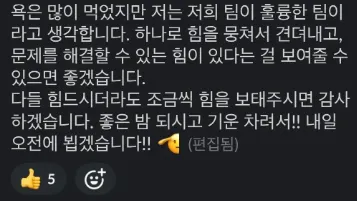
Actually, it was precisely because there were hard times like this that, if anything, the teammates grew closer, and I was able to think about how I want to live going forward. My health also got a bit worse during this period; there was even an incident where I suddenly fainted while getting fitted for a suit. It was probably vasovagal syncope (it happens sometimes… like when I’m on a plane or something??) and stress is said to be the main cause. Whatever the case, health comes first. You have to live healthy to do anything fun.
No matter how hard something is, it ends someday - Hayao Miyazaki
Anyway, while going through this series of experiences, I think I personally grew at a compressed pace. Not only was I involved in the entire LLM post-training process, but I was also able to take on organization-level work like PR activities and external talks. The phrase I said most this year was “I’ll do it,” and that’s how I got to do a lot of things and rack up experience quickly. On places like LinkedIn, a lot of people say the more capable you are, the more you offload work, but personally I don’t really agree. If you want to grow more, I think the right direction is to give yourself more responsibility, pour in time, and push yourself into times of immersion. By a junior’s standard, of course, haha.
In the end, I think I became a fairly useful person. During my hiring interview I was given the task of imagining myself at SKT 10 years later, and at the time I wrote that I wanted to become “the all-purpose problem solver that colleagues at SKT come to first and most comfortably when they hit a problem.” This year I think I actually achieved that goal somewhat. I became someone the organization sought out a lot, and I was able to work with great joy. Didn’t Elon Musk also say that usefulness is the highest value an engineer can have (source: Firechat with Elon)? On top of that, this growth was also reflected in my evaluation at the company. I’d always wanted to get the top rating at least once before eventually leaving this company, and I was glad to achieve that goal.
Things I want to protect
If I had to pick one of the events that define this year, it would unquestionably be marriage. We dated for six whole years, but it feels fresh and fun all over again now that we’re married. I’d wanted a tear-free wedding, and we filled the ceremony with only fun content, no officiant. We did an after-party too and the whole day just disappeared; by the end I was really sleepy, but it was such an exciting and fun wedding. Someone said the wedding day itself is so exhausting, but I wasn’t nervous at all and had fun. I was so grateful that so many friends came to celebrate. I’m just sorry I couldn’t greet each and every friend who came right there on the spot.
If you ask me what’s best about being married, I think it’s getting to share daily life together every weekend. These days on weekends we don’t go anywhere, we cook and eat, watch Netflix, each do some of our own work at home, then go out for a walk—an utterly unremarkable kind of rest, and it’s just so good. Also getting to eat my mother-in-law’s food often… (I really wish she’d go on Culinary Class Wars).
Strangely, after marriage my mindset about my career shifted a bit. It’s a bit cliché, but I now have something I want to protect. The feeling that, small and precious as my family is, I want to protect it no matter what. The desire to protect that comfortable weekend routine. The desire to protect my wife, who runs a startup, so she doesn’t lose her dream. I started feeling that I should work harder and earn more. If anything, once what I want to protect became clear, I started focusing on my career more. My beloved wife and family became a huge driving force for my life.
Historically, Koreans are a people more accustomed to defending what they have than to expanding.
I’ve long been someone for whom protecting the downside was important. I believed that going to a good school and getting a good job propped up the downside of my life, and that protecting this is what builds a stable life. At the same time, I felt regret that this mindset kept me from living a more challenging life. But this time, what I want to protect was a bit different. How should I put it—the desire to protect it makes me more challenge-seeking? Maybe it’s because of the thought that it’s something I could lose if I mess up. A school or a job, once you lock it in, there’s nothing to lose or not.
Anyway, ironically, now that I have a precious family, I feel even more like taking on challenges!! Beyond that, it occurred to me that when I become a leader and have precious teammates, I’d work even harder to protect them.
Toward a bigger world
This is a bit out of the blue, but let me talk about basketball for a moment. I first started playing basketball in 2011. I love playing it myself, but I also never miss watching NBA or KBL games. This year, our country’s men’s national basketball team wrote a moving drama. They successfully achieved a generational shift at the Asia Cup, and in the Basketball World Cup qualifiers they beat China—who have ex-NBA players—twice in a row. At the center of that emotion was a basketball player named Hyunjung Lee.
Hyunjung Lee was born in 2000, so he’s 25 now, and I’d watched him play ever since his Samil Commercial High School days. He stood out in the U-17 and U-18 international tournaments, and after graduating high school he challenged the U.S. NCAA and finished his junior year. Sadly he couldn’t make it to the NBA due to injury, but he’s continuing his pro career playing in the Australian and Japanese leagues.
Money isn’t important. Right now, the challenge matters far more to me. - Hyunjung Lee
In 2024-2025 he began playing in earnest as a senior national team member, and honestly I was floored. He had become a player at least two or three levels above our country’s pro players. To the point that it’d be rude to compare him with players his own age, he had become a player who could stand alongside the basketball players in Korean history. Experiences in a bigger world change a person like this; rather than being trapped in a well, the times of challenge where you somehow collide with things and overcome them can produce growth this fast—I felt all of this through Hyunjung Lee.
To survive in a big market, effort, will, and grit are forced upon you. There are so many incredibly talented people that you can never become complacent. I too came to a resolution that I have to step out into a bigger market. I think this resolution carries even greater meaning because it was a realization that came not from the work I do, but from basketball, which I love most. Anyway, once I’d resolved to become an engineer, I started feeling that I wanted to work with and compete alongside the world’s top engineers. The goal is to work at a Big Tech company in mainland USA before I turn 35. As the first step, I chose to change jobs to become an AWS applied scientist.
The team I applied to is the custom model optimization team under the AWS GenAI Innovation Center APAC, a team responsible for deep-level training—from continual pre-training to RL—of the models customers request. The work itself doesn’t seem like it’ll change much, but I felt I’d be able to learn how to create and make the case for direct business value through work a little closer to the customer level. I was really glad I could go to a team where I can maintain career continuity while also working in English.
If you only try to be number one in a closed market, you may end up falling behind in the long run three years later. I think it’s important to keep looking at the broad market. - Jinwoo Kim, CEO of Liner
There’s fear about the new environment and work, but I’m also looking forward to the thrill of learning something new. I’m going to run until I can grow even faster than before and relocate to mainland USA. To match timelines with my wife, who dreams of founding a startup in the US, I’ll have to work even harder!!
The regrets that remained nonetheless
Even though this was a year where I went through major events and took a step forward in both life and career, there are still some things that left me with regret.
At work, the things I didn’t push harder on remain as regrets. I think back to moments where I wonder whether things would have turned out better if I’d taken more leadership and proactively voiced my opinions in the LLM post-training process. Why didn’t I argue sooner that we should put more resources into RL? Why couldn’t I argue strongly that we should lower the priority of work other than the PFM? These things stick in my memory. Also when the first junior who joined was taken to another team after just a month… though of course it probably wouldn’t have changed anything even if I’d pushed.
In the end, it was a year where I realized that I’d grown a lot as a contributor but am still very lacking as a leader. I did everything well and people sought me out a lot, but I don’t think I exerted the kind of influence that pulls teammates together into one or helps the people around me grow more. Of course I thought that wasn’t my role, but even that feels like an excuse. If you do it, you do it—what does “not my role” even mean? At AWS, I want to build the capability to have a positive influence and lead not just myself but the people around me too.
Someone like you, who’s good at a bit of everything, is welcome anywhere. But the people who ultimately become leaders are those who’ve built up experience agonizing over and solving one particular thing for a long time. Going forward, I hope you give that some good thought. - During an exit interview with an SKT executive
It was also a little disappointing to leave without fully wrapping up the PFM project. I feel a lot of guilt toward my SKT colleagues. And toward my precious peers, too. Having friends at work is a truly, truly, truly great thing. You always have a place to rest your heart. I hope I can make lots of close friends at the new company too.
On the life side, this year I really neglected exercise. I think I barely played basketball or tennis, and I neglected weightlifting so much that I definitely lost a lot of muscle. Since my weight stayed the same, it probably all turned to fat ㅠㅠ My forward head posture definitely got worse and I have occasional back pain, plus I caught a cold, which I usually never do. Above all, I started sleeping in for long stretches on weekends. I can feel my stamina has dropped a bit. You need stamina to back you up to steadily run both your work and your life.
I also feel like I didn’t get to spend much time with friends. Honestly part of it is that spending time with my wife became so much more fun after marriage, but there are memories you can only build with friends, aren’t there? I feel like this year I sorely lacked memories of traveling with friends or doing something really fun. Even so, I was so grateful that they all came to the wedding, exchanged year-end well-wishes, and warmly said goodbye when I left the company.
In 2026…
Now my goal is clear!! To go to the US before I turn 35! A bigger world is right in front of me, within arm’s reach, and yet there were past days when I defined my own limits as if it were a story from another world.
In life, you have four bullets, each lasting five years, from age 20 to 40. You have to think carefully about how to use them. - A senior from my lab
I have no regrets about the second bullet, when I resolved to become an AI engineer. Now that I’m 30, I intend to use the third bullet as a stepping stone toward going global, and the fourth bullet to make my mark on the global Big Tech stage. Let me take on more, and solve more. Let me not get trapped in a mold, and keep stepping out of my comfort zone.
Here’s a thought I’ve been having lately: today is better than yesterday. I’m not sure why. Even if that stops being true, I want to keep living with this mindset. Anyway, in 2026 too, I hope days where today is always better than yesterday keep going on and on.